
MODERNE ART: SCULPTURE
Selected works
MICHEL SAUER, Sänfte Mandarin
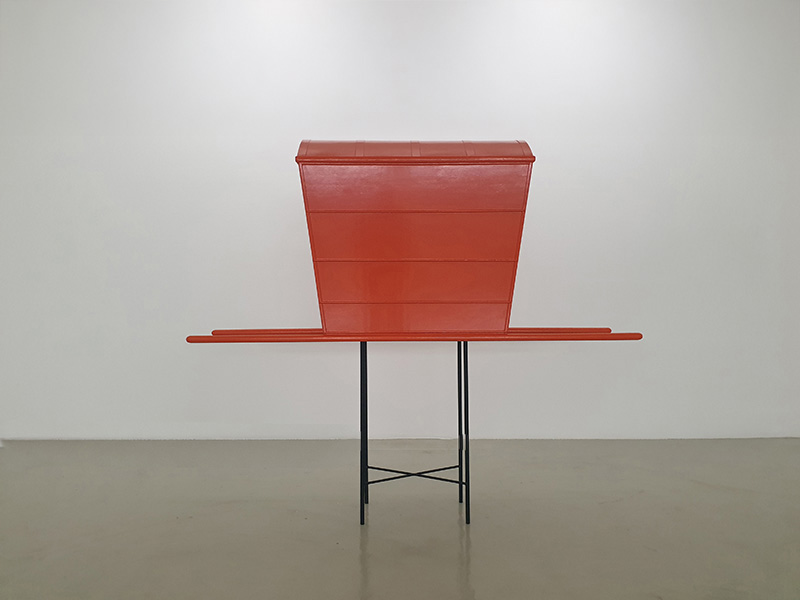
MICHEL SAUER
Sänfte Mandarin, 1992
Wood, lacquer, metal
200 cm H
Michel Sauer develops a visual language in his work that moves between sculpture, object, and spatial memory. The piece “Sänfte Mandarin (Palanquin Mandarin)” from 1992 refers to cultural and historical forms of transport and transforms them into a contemporary sculptural situation. The starting point is the traditional litter as a symbol of movement, status, and human presence.
In his artistic realization, Sauer dissolves the original functional context of the object and transforms it into an open space for thought and experience. The sculpture appears both archaic and contemporary, familiar and distant. Through its reduced formal language, the work creates a quiet, almost meditative atmosphere in which questions of burden, protection, memory, and cultural identity resonate.
Characteristic of Sauer’s work is the balance between material presence and poetic openness. The “Palanquin” is not understood as a purely functional object, but as a carrier of stories, images, and associations. The empty interior refers simultaneously to absence and movement, opening up an imaginative access for the viewer.
With Sänfte Mandarin, Michel Sauer creates a sculpture that connects past and present and makes space perceptible as a site of memory and reflection.
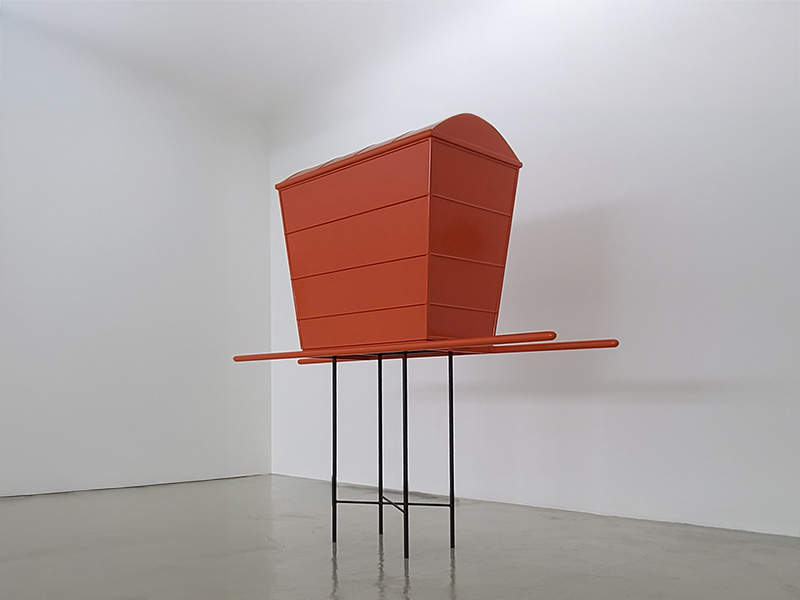
After its presentation in 2017 at the Museum DKM on the occasion of the exhibition “Ernst Hermanns and Six Award Winners from Seventy Years. 70 Years of Junger Westen”, Michel Sauer’s work Sänfte Mandarin is now recontextualized within the current exhibition setting in terms of art history. That earlier presentation brought together artistic positions from different generations, including Otto Boll, Emil Cimiotti, Ernst Hermanns, Stefan Kern, Gereon Krebber, as well as Heike Mutter and Ulrich Genth, and highlighted both continuity and transformation in sculptural inquiries within postwar art.
With its renewed presence in the museum, Sänfte Mandarin now enters into a visual and conceptual dialogue with works by Gianfredo Camesi (1940–2025) and Raimund Kummer (1954). This constellation opens up correspondences that particularly address questions of spatial perception, bodily reference, and the poetic charge of the object. Michel Sauer’s sculptural practice moves between concrete form and metaphorical openness; everyday and cultural forms are detached from their functional context and transferred into a contemplative experiential space.
In this context, the work appears as an object of transition: between movement and stasis, presence and absence, archaic reference and contemporary spatial conception. In its encounter with the conceptually and spatially oriented practices of Camesi and Kummer, it becomes evident to what extent Sauer’s work participates in an expanded definition of sculpture—one that is not understood solely as an autonomous object, but as a carrier of memory, imagination, and spatial experience.
The title Sänfte Mandarin (Palanquin Mandarin) additionally unfolds a subtle web of linguistic and cultural associations. The word “Mandarin” immediately refers to High Chinese, while at the same time evoking images of East Asian culture, courtly rituals, and historical memory. This layer is further intensified by the sculpture’s warm orange coloration – a tone reminiscent both of the mandarin fruit and of the orange. In traditional German usage, the orange is referred to as Apfelsine, literally meaning “apple from China.” Within this seemingly incidental linguistic shift, a delicate symbiosis of word, color, and imagination reveals itself quietly within the work.
Inevitably, inner images begin to emerge: sedan chairs carried through the streets of Beijing, Shanghai, or Hong Kong; slow movements through dense urban spaces, through history, memory, and cultural projection. At the same time, the surface of Sänfte Mandarin appears veiled by a faint haze – as though covered by dust, smoke, or atmospheric residue. It is precisely this quality that lends the sculpture its dreamlike aura and evokes associations extending far beyond the object itself: echoes of colonial imagery, of the mysterious and heavily romanticized visions of the so-called opium dens, and of the historical tensions and wounds left behind by the Opium Wars between China and the United Kingdom.
In this way, the sculpture unfolds a narrative depth that resists fixed interpretation. It invites the viewer to lose themselves within imaginary spaces, historical fragments, and personal visions. The work becomes an open vessel for projection, remembrance, and storytelling – a sculpture that offers not a singular narrative, but rather the possibility of infinitely unfolding inner narratives.
In this interplay, it almost seems as though Sänfte Mandarin had been created from the outset for precisely this space and its specific aura.
Günther Schloß, 2025