
MODERN ART: SCULPTURE
Selected Works
Raimund Kummer, Three Green Leaves
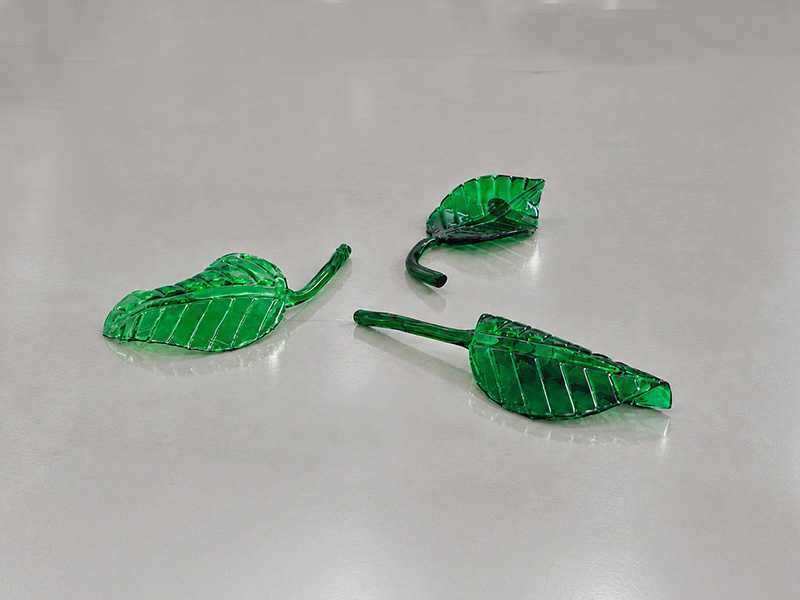
Three green leaves made of Murano glass tell the story of a place they have left behind and a past that continues to resonate within them. Raimund Kummer’s work connects traces of history with questions of transience, memory, and what we leave behind. It offers a meditation on the mysterious power of things that encounter us in the present moment and set our imagination in motion.
RAIMUND KUMMER
Drei grüne Blätter, 1993
from: Via vetro verde
Green Murano glass
approx. 106 × 63 × 26, 126 × 39 × 16, 117 × 58 × 16 cm HWD
Abandoned Leaves That Remain
Three oversized green leaves made of Murano glass lie on the floor of the exhibition space. They are the work of Raimund Kummer. On three sides of the room hang monochrome paintings by Gianfredo Camesi. They appear like windows in the walls of a courtyard. Through them, we look into other rooms and, at the same time, into an intangible distance. The monochrome surfaces seem to open up depth without revealing any particular place. The gaze can lose itself in them and imagine a world beyond the wall. Yet this distance remains undefined. It can be seen, but never reached.
The windows open up the courtyard without dissolving its walls. The space remains enclosed, yet extends beyond itself.
The three leaves lie on the floor of this courtyard. But there is no tree from which they might have fallen. They are foreign bodies in this space.
How did they get here? Were they blown across the rooftops? An unlikely possibility. For although they appear transparent and their green color makes them seem light, almost weightless, glass is heavy. The leaves could not simply have been carried here by the wind. Their lightness is an optical illusion; their weight is a material fact.
In autumn, ordinary leaves fall from trees and cover the ground in shades of golden yellow, yellowish brown, and red. Their colors tell of passing, of the end of a life cycle. These three leaves, by contrast, glow with a fresh, almost unreal green. They seem to defy autumn. They have fallen without withering. Glass preserves their form while simultaneously removing them from the natural cycle.
Where Do They Come From?
Their story leads to another place, far away. In 1993, Raimund Kummer created the installation Via Vetro Verde at the Museo delle Navi Romane on Lake Nemi, south of Rome. There, he placed numerous green glass leaves along the exposed traces of an ancient road that led to the sanctuary of Diana. On this old path, Kummer’s glass leaves encountered traces of a past that was no longer immediately present, yet continued to endure in the ground, in the remains, and in the history of the site.
Now three of these leaves are in another place. They have left their original context. In the museum, they lie on the floor of the courtyard, surrounded by the windows that Camesi’s monochrome paintings open in the walls. What have they brought with them from their former location? And what happens to them when they enter a new spatial order?
Their relocation does not mean that their story has come to an end. They enter a new context without losing their origins. Perhaps this touches on an idea that shapes Museum DKM: preserving art means more than protecting it from disappearance. It also means giving it a place where it can continue to have an effect. The works in our collection come from different periods and cultures. What connects them is not a shared era, but a quiet beauty that reaches beyond the time of their creation and reveals itself anew again and again.
The writer Frank Schablewsky drew my attention to the linguistic ambiguity of the English word leaves. It is the plural of leaf, and at the same time the third-person singular of the verb to leave. In this single word, an object and a movement meet. The leaves lie still on the floor, and yet the word itself seems to set them in motion.
Leaves. Leaves. Leaving. Departing. Leaving behind.
Perhaps the leaves also tell a story of leaving things behind. But could they be something other than ordinary leaves? Might we see in them three lost leaves from a laurel wreath?
Since antiquity, the laurel wreath has symbolized victory and glory. It crowned poets, generals, and heroes. But there is no wreath here. Only three individual leaves remain, detached from the context that would have given them meaning.
Did someone lose them? Was a wreath laid aside? Was a hero once in this room?
Perhaps he has already departed. Perhaps the leaves are the last witnesses to a presence that can no longer be proven. The hero remains invisible; the wreath has disappeared. Three leaves lie on the floor, possible signs of a glory whose bearer is no longer present.
Here, the two meanings of leaves intertwine. The leaves might be remnants of a laurel wreath; to leave might describe the departure of the person who wore it. In that case, the leaves would not merely have been removed from their original place. They would also be what someone left behind: signs of an absence, traces of a person whose story remains beyond our knowledge.
But perhaps the opposite is true. Perhaps no one lost the leaves; perhaps no hero was ever in this room. The idea of the laurel wreath may arise only in our gaze, because we see three leaves and search for a story to explain them. The hero, then, would not be the origin of the leaves but a figure we invent. We leave the immediate sight of things behind and enter a possible story.
While our gaze travels outward through Camesi’s paintings into an undefined distance, the leaves have arrived from somewhere else. They carry the memory of another, very real place. The idea of the laurel wreath introduces yet another movement: someone might have left this room. What remained of that person would be three leaves.
Many years ago, I gave a friend and admirer of the museum small, palm-sized oranges made of Murano glass, which I had purchased myself in Murano. When we recently spoke about the green glass leaves, he said, “Now I’ll have to look at the oranges in a completely different way.”
He is right. The little, precious oranges still have their green leaves. These are the exact opposite of Raimund Kummer’s oversized leaves: here, small leaves attached to fruit; there, large forms lying alone on the floor. And yet their shades of green are precisely the same.
Another connection can now be traced through the museum. It leads to Erwin Wortelkamp’s work Oranges for Hans von Marées, which refers directly to Hans von Marées’s frescoes in Naples. Starting from Kummer’s green leaves, a web of relationships opens up between different works of art, personal memories, and artistic explorations.
Perhaps an apparently insignificant detail is enough to change the way we perceive things. Every visitor may discover a story of their own—and a world that emerges only through looking. Perhaps this is where the particular tension of this constellation lies. The leaves are heavy yet appear light; they are imperishable yet evoke transience. Their green seems to hold time still, while their position on the floor recalls what falls, passes away, and remains behind.
Leaves
Leaves that have left a place. Leaves that someone might have left behind. Leaves that may once have belonged to a wreath crowning a victor or a hero.
What remains of a place when something has left it? What remains of a person after they have departed? And what does something carry with it when it reappears somewhere else?
Perhaps the three leaves are remnants of a place where history has been inscribed in the ground. Perhaps they are lost leaves from a laurel wreath. Perhaps they are simply three green glass leaves whose unfamiliar presence sets our imagination in motion.
We do not know. We see three leaves that do not wither, even though they have fallen. They lie heavily on the floor, looking as though they could be carried away at any moment.
Yet they remain.
The Story of the Leaves
In 1993, Raimund Kummer was in Rome as a fellow of the German Academy Rome Villa Massimo. During this period, he created Via Vetro Verde. For the installation, he placed numerous green glass leaves along the exposed traces of an ancient road at Lake Nemi. The road once led to the sanctuary of Diana. In doing so, Kummer brought his contemporary work to a place whose history reaches far beyond Roman antiquity.
Lake Nemi lies southeast of Rome, nestled among the wooded slopes of the Alban Hills. The lake and its surroundings possess an extraordinary historical depth. The sanctuary of Diana Nemorensis once stood here, surrounded by a sacred grove. Diana[1] was worshiped as a goddess associated with forests and nature, fertility, and childbirth.[2] The sanctuary was one of the important cult sites of ancient Latium; its origins reach back to pre-Roman times. The landscape was therefore not merely a natural environment but also a religious space. The forest, the lake, and the paths leading to the sanctuary formed a setting in which human beliefs, rituals, and traditions endured over long periods of time.
The sanctuary at Nemi is also associated with the tradition of the Rex Nemorensis, the “King of the Sacred Grove.” Ancient authors report that the priest of Diana had to defend his position in combat against a challenger. The historical accuracy of the details of this tradition cannot be established with certainty. Nevertheless, they bear witness to the mysterious aura that surrounded this sacred site already in antiquity.[3]
Centuries later, the lake acquired a different significance. In the first century CE, Emperor Caligula had two enormous ships built on Lake Nemi. Their elaborate furnishings and technical features testified to an extraordinary level of expenditure. The ships belonged to a world of imperial power and representation, whose traces overlapped here with the older history of the sanctuary. After they fell out of use, their remains sank to the bottom of the lake. It was not until the twentieth century that they were recovered and exhibited in the Museo delle Navi Romane, a museum built specifically for this purpose. Their recovery made a submerged past materially tangible. During World War II, the recovered ships were destroyed in a fire at the museum.
At Lake Nemi, different layers of time thus converge: the sacred site of Diana, the religious traditions of the grove, the power of the Roman Empire, the traces of an ancient road, and the rediscovery of a submerged past. Not everything has survived. Some things have disappeared; others remain only in fragments. The history of the place emerges through remains, archaeological finds, and narratives that carry the past into the present. Perhaps part of its distinctive aura lies precisely here: in the proximity of what once existed and in the impossibility of recovering it in its entirety.
It was into this historical landscape that Kummer placed his green glass leaves. They were not archaeological finds and did not belong to any of the past eras. They entered an environment whose significance had been shaped by all these stories. The glass preserved their form and gave them a permanence denied to natural leaves. At the same time, they entered into a relationship with a past in which what had vanished and been lost remained present.
For a brief time, Via Vetro Verde connected the present with a past that endured in its remains. The leaves lay along the traces of an ancient road without themselves becoming historical artifacts. They belonged to their own time, yet encountered one far more distant. Perhaps this is what makes the work quietly remarkable: for a moment, it made visible how the present and the past can touch.
Günther Schloß, 2026
References
Kummer, Raimund (ed.). Via Vetro Verde. Museo delle Navi Romane, Nemi / Accademia Tedesca – Villa Massimo, Rome, 1993. Exhibition catalog, 31 pages, illustrated. Texts by J. Schilling and P. Friese.
Banz, Claudia / Schreier, Christoph (eds.). Raimund Kummer: For Your Eyes Only. Works 1978–2009. Kerber Verlag, Bielefeld/Leipzig, 2009. Exhibition catalog, Kunstmuseum Bonn.
Strabo, Geography, 5.3.12; Ovid, Fasti, 3.263–272; and C. M. C. Green, Roman Religion and the Cult of Diana at Aricia. Cambridge University Press, 2007. https://penelope.uchicago.edu/Thayer/E/Roman/Texts/Strabo/home.html (accessed October 24, 2026).
[1] In Roman religion, Diana was the goddess of the hunt, forests, and the wild. She was also associated with childbirth and the protection of women and children. Her Greek counterpart was Artemis.
[2] Strabo, Geography, 5.3.12. English translation by H. L. Jones, The Geography of Strabo, Loeb Classical Library. Available online: https://penelope.uchicago.edu/Thayer/E/Roman/Texts/Strabo/5C*.html (section 12; accessed October 24, 2026).
[3] See Suetonius, Caligula, 35.3; Pausanias, Description of Greece, 2.27.4. On interpretations of the Rex Nemorensis, see James George Frazer, The Golden Bough: A Study in Magic and Religion, Chapter I: “The King of the Wood.”